

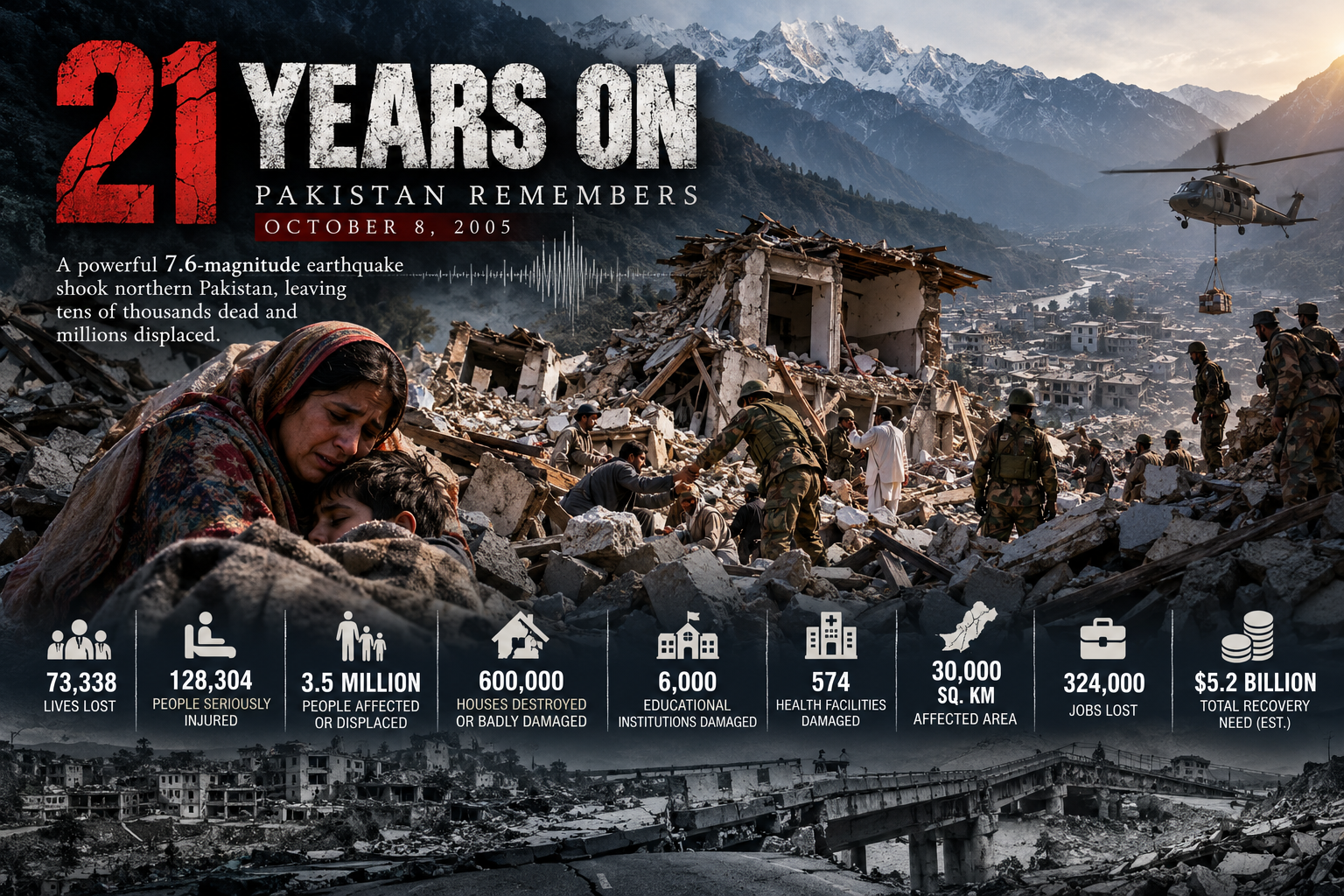

Web Desk: Pakistan is marking 21 years since a powerful earthquake devastated parts of the country’s north, killing tens of thousands of people and leaving millions displaced in one of the country’s worst natural disasters.
The 7.6-magnitude earthquake struck at 8:52 a.m. on Oct. 8, 2005, affecting large parts of northern Pakistan, Azad Jammu and Kashmir and Khyber Pakhtunkhwa.
Within minutes, homes collapsed, schools were destroyed and roads and bridges were damaged, cutting off numerous communities from the rest of the country.
The disaster claimed 73,338 lives and left about 128,304 people seriously injured, according to figures cited in assessments of the earthquake’s impact.
Around 3.5 million people were affected or forced from their homes, while roughly 600,000 houses were destroyed or badly damaged.
The destruction also extended to vital public services. Nearly 6,000 educational institutions and 574 health facilities were damaged or destroyed, while the affected area covered about 30,000 square kilometers.
Beyond the immediate loss of life, the earthquake disrupted livelihoods and economic activity across the region.
According to World Bank assessments, the disaster wiped out about 324,000 jobs, adding to the enormous burden facing communities already struggling to recover from the destruction.
The scale of the damage created a major reconstruction challenge for Pakistan.
Early joint assessments estimated that approximately $5.2 billion would be required for relief, recovery and rebuilding. Of that amount, around $3.5 billion was needed to restore housing, schools, health facilities, roads and other critical infrastructure.
The earthquake therefore left damage far beyond collapsed buildings. Families lost sources of income, while communities faced prolonged disruption to education, health care, transportation, electricity, water supplies and communications.
As the scale of the disaster became clear, Pakistani authorities launched a large rescue and relief operation.
The military played a significant role alongside civilian emergency agencies, doctors, volunteers, charities and international relief organisations. Army personnel, engineers, medical teams and helicopters were deployed to reach communities isolated by damaged roads and difficult mountain terrain.
Rescue teams searched collapsed buildings for survivors and recovered bodies, while helicopters helped evacuate injured people and deliver food, tents, medicines and other essential supplies to areas cut off by the destruction.
Military engineers also worked on restoring damaged roads and other infrastructure, helping reopen access to communities that had been isolated after the earthquake.
At the same time, thousands of civilians and humanitarian workers joined the response, reflecting a broad national effort to assist those affected.
Twenty-one years later, the earthquake remains deeply embedded in Pakistan’s national memory.
For survivors, the disaster was not simply a matter of statistics. Families lost parents, children and other relatives, while many communities had to rebuild their homes and livelihoods from the ground up.
The passage of time has rebuilt much of the physical infrastructure, but it has not erased the human cost of the disaster.
Oct. 8 is therefore remembered not only as a day of immense loss, but also as a reminder of the importance of preparedness, solidarity and coordinated emergency response.
Pakistan continues to honor those who died in the earthquake while remembering the rescue workers, soldiers, doctors, volunteers, charities, international organizations and ordinary citizens who helped communities through one of the country’s darkest moments.
The earthquake lasted only moments. Its consequences, however, shaped the lives of millions and remain part of Pakistan’s history more than two decades later.
Read more: Students demand answers as assault spark violent protests at Indian University
